Opening to whatever light there is…

Spring is taking its own sweet time coming. It’s been cold and gray, icy some days and pretty much frosty every morning. I feel as frozen inside as the weather is outside.

We are waiting for our court case to work its way through the system, in the hopes that we might, in the end, be allowed to see our now motherless granddaughters. I just found out for certain that my job, as it exists is going away, not just for me, but for all those who hold the position of store graphic artist at Whole Foods. A chronic health problem is vexing my husband, putting him into a mood as dour as the weather.

And I have been flooded by flashbacks of this time last year, to the anxious moments when my daughter Caitlin was first in rehab, then charged with involuntary manslaughter, then kicked out of rehab for not being emotionally able to manage her program after being so charged, cuffed out by her PO to be transported first to the Portage County jail, then to Summit County jail maximum security, then back to Portage before being released on house-arrest. Those were trying days. Yet as nerve-wracking as they were in real time, I still had hopes for her all that spring that she could put all of this behind her. My hopes evaporated last August, …just gone with her last breath. Even my spiritual practice is now shrouded by this grief. I tried engaging in an ADF daily shrine building exercise until I couldn’t bear to take down and rearrange any of the items in the shrines that were the most evocative of her.

Despite the lingering chill, snowdrops and crocuses are popping up all over my garden and lawns. A few overnight snows have flattened them low in these weeks while they worked their way to the surface, but they perked their heads back up defiantly. Under the gray skies of the late afternoon when I arrive home they’ve closed their torch-shaped buds, so day after day I have been missing their perky faces. They can be shy when there is no sun. This still doesn’t stop me from fondly remembering how they first arrived years ago: in netbags as corms from mail-order nurseries, as wedding party favors when I married some friends at a local winery, and especially when I popped them into the ground with a dibble, bouncing adolescent Caitlin assisting or mostly poking around nearby in exploration, as part of our home-schooling science curriculum. She used to revel in the fact that she could look out her bedroom window to an enviably carpeted tapestry of bold crayon-hued blossoms.

Last Thursday I had the day off. It was, of course, again raining, although this time warm and gentle for a change. I marvelled at how many new clumps of crocuses and snow drops emerged this year from seeds and cormlets distributing themselves about through seasons past.  I wanted so badly to call Cait on the phone, to invite her over to smoke on the patio and see how the goldfish in the pond have grown over the winter, and to especially to see how our crocuses have spread themselves so riotously about the lawn. It was such a gloomy day, yet I noticed at the noontime hour that crocuses had opened themselves in spite of the gray, trying to maximize their chances with whatever light that could be had at the mid-day hour. Their goblet-shaped blooms filled up with raindrops while blithely stretching themselves wide for some short hour, hoping for a brave bee or a rolling raindrop to carry their pollen to and fro.

I reflected in that moment about how much a gray cloud has clung over me, beginning with the struggle to help, not only one but two loved ones, who have suffered so from substance use disorder, then through such a horrible loss and the  cascade of uncomfortable life changes that flow inevitably from that day. The uncertainty at work has not helped and the anger I have felt about not being able to comfort Caitlin’s girls and gain my own healing by feeling the joy of them in my life has at times been paralyzing. The spirit of those wee flowers gave me courage to try at least to open in my own small ways to whatever light is available to me in my life. To catch the gleam from a world of possibilities even when the tears fall like rain into the cup that is my heart.

Certainly, I try to be mindful of an abundance of blessings to be counted and joys to be experienced with friends and kind co-workers, my husband and my other children and grandchildren. I’m not knocking the dark either, whose comforting cloak has given me a place to hide and heal in. It’s not that the gray will go away, but being shut closed all the time in response to it will mean I will never accept the warm fertilization of creativity and passion that has kept me going through tough times in the past and helped me reach out to others in need.

So hail, friend Crocus and brave Snowdrop!

Soon the cavalry of golden daffodils and blue hyacinths will push you aside, but for now I will drink in the inspiration of your rain-filled chalices should you continue to be brave enough to share these with me in spite of more gray days ahead. And perhaps the Sun will join us.


Try to be whole, try not to overthink

“A Comhla breac is a rock in the mountain which opens once in the seven years. The nearest person to the Comhla breac would be swept in. There is a Comhla breac in Pairc Mhór and it opened this year at night and it woke three women. There is one in Doire Dubh and a dog was swept in and he came out after a time with a leath ceann. There is a big Comhla breac in Glen Flesk in Kerry a man from Bantry went in there one night by mistake a woman came from another room two times and if he stayed there until she came the third time the rock would have shut. Each time she was caoining but she did not speak atall.”

– dúchas.ie, The Schools’ Collection, Co. Cork, Barlinn, Bridgie Flynn, collector

At our Stone Creed Yule this last season at the end of 2017, I took an oath to resume writing my blog, Comhla Breac, a name which translates to “the Speckled Gate.” This is, of course, in a peculiar Irish way, where “speckled” is a color like the coloring of trout or of certain dogs and horses, spotted, freckled, in a way like my own face. It’s an Otherworldly color, like the changing mauves and grays of twilight and the dappling of light and shadow, also akin to checkering.  The Irish digital literary journal Breac asserts that breac can also mean “to write, to carve, to illuminate, to ripen,” an assertion I wish to explore more deeply.

For me Comhla Breac began in 2015 as a fledgling writing effort, during a time when I was doing a lot of other composition. I had taken a Filedecht intensive on medieval Irish poetry and its courtly culture, from noted polytheist PSVL, so I was churning out triads, praise poems, even full length ballads. I had applied myself to the Ar nDraiocht Fein Naturalist Guild curriculum and received some inspiring accolades from my evaluator, so a blog seemed an ideal place to further flex my literary muscle.

And then, in late 2015, my daughter confided to us that she was suffering from an ever worsening opiate addiction. Her older brother, already a veteran junkie, had brought me so much anxiety and suffering over the years before this, but I thought I had found my own way to a reasonably detached place with his illness by this point. He had done several stints behind bars, moved to the westside of Cleveland, and was now too far away to be seen scratching and nodding off or slurring his words in that telltale way, too far away to just show up and ask me for money or take it when I wasn’t home. Alas, he was also too far away to sound any kind of alarm about his sister’s transition from a pain management patient to a pillhead, then to a fearless, and maddeningly driven, street drug user.

I abruptly turned away from all my blogging, spiritual writing and studies, and began instead to focus on her. I wrote her voluminous texts over-flowing with happy memories and my faith-filled aspirations for both of us. When she found her way into treatment, got sober and stayed that way for seven months, it was to her I wrote praise poems. When she got charged with manslaughter in the death of someone who had used with her the year before, I strained to write hopeful missives and even grateful celebrations, as she miraculously made it through the early impact of those unnerving charges without relapsing. When she wrote to me of her sorrow over not being able to be with her daughters as they prepared for their first day of school in August last year, I evoked to her a future where we would all be together again, and how the joy would fill all of us when reunited we all would be.

I wrote her a text one night that she never answered. The next day her phone went right to voicemail, indicative of a full and unlistened-to supply of worried messages from all of us who loved her. The following day saw me standing under the hot eclipsing sun, waiting for the police to arrive, waiting for her landlord to open the door, waiting for the medical examiner to carry her still winsome shape out in a white shroud, to lay her no longer breathing body in that long green, and these days, too-oft-summoned van with its ominous plaque on the door.

Now I find myself back at the Speckled Gate, a blog I blithely began before I knew how bad things could get and how tenuous the life of a fierce girl could be when street drugs involve contamination with Chinese carfentanil. I now find myself writing shadowy entries in my head while I’m driving or sitting, yet I get paralyzed instead at the keyboard, overwhelmed at times by what to write about. Comhla Breac was supposed to be a nifty blog about my spiritual journey, but my spiritual journey of the last two years has been at times completely exhausting, like that night-ride on the back of an otherworldly horse that lasts seemingly for years in a place between the worlds. I often think I need to write some about the comfort I have found with my Nar Anon family group, certainly more so than I have from some of my own relatives, who seem mired in scapegoating, blame and inflexible prejudice. But other days I think I should just write about knitting patterns, or fruit tree saplings, or the best recipes for plant-strong rice bowls. All in all I hope that as a project this will lead me back to my Druidic studies and to more poetry.

I was, as related, above the nearest person to a Speckled Gate when it opened wide.  My daughter and I were swept in for a time, only she never came back out. I alone have been cast back out amongst you, disoriented and seeking grounding, not only in deepening spiritual practice and communion with my allies amongst the gods and spirits, but also in the simple practices, crafts and skills I have cultivated through my life. Expect in the future to glimpse some of these if you peer through the dappled light of this gate.   …At least expect so for the next year, because my Oath entails submitting at least one entry per month until next Yule, at least.  And I have roused myself enough from a kid of integrative over-thinking to post this in under the wire tonight for January, …so “Go me!”


A Beacon Fire

“I call upon the powers of Coire Goirath, Cauldron of Warming & Incubation. Grant me stamina & strength to faithfully continue my practice…As a token of this inner fire, I vow to begin a discipline of fire-keeping, to gain confidence around a skill that I have always turned toward others to build & tend.”

When I swore my Druid’s Dedicant Oath, I made three vows to correspond to the medieval Irish Cauldrons of Poesy, which included the above words. That oath was sworn in April before an assembly of good ADF woman-folk, and my DP work was completed before summer’s arrival. I have made some good strides in keeping parts of my oath. Yet until last week I had not really commenced any work towards this promise of fire-keeping.

I have no problem lighting things on fire, really. I have a little iron cauldron for burning loose incense, a reliable practice of candle spell-work. I am no slouch around a cooking stove or our woodstove. Yet, even in the past as a high-priestess, coven-running more than a decade, I’ve relied on someone else to build sacred fires for me. (Hey, somebody had to keep the script, offerings, spell components all in order, not to mention keep an eye on all those pent-angling blades.) I also tend to work with people who really excel at fire-building, even pyrotechnics!, so its been easy to step back and let them take that lead.

Recently, I have given thought to the notion that fire-tending is the basis of all other ritual, certainly one of the oldest ritual acts. In my own mystical experiences I’ve encountered fire-spirits, dancing with them at rites, they happy to leap about to my rhythm, slithering amongst the coals like salamanders of occult description. Usually my methods of transformational magic are more slow-acting, like compost, cooking languidly, releasing energy over time.

I seek to initiate a practice of fire-keeping that is intuitively reliable and comfortable. When I was invited to participate in the fire-rite “Beacons in the Dark: a Global Anti-Fracking Convergence,” I took it as a summons for me to honor my oath. The goal of this convergence contained a weird contradiction of sorts, kindled with magical intent, yet in small groups across the globe, isolated from one another and invisible to any actual frackers. We would all be building a fire fueled by hydrocarbons to resist and to protest one of the worst kinds of fossil fuels extraction. As I mentioned my intent to my husband, he responded incredulously, “Are you really going to build a fire tonight?”

It’s here that I have to confess that I had another chthonic goal. Flammable brush about the yard had been accumulating in piles and in our fire-pit itself. This debris constituted a real obstacle for me mentally in commencing any real fire-tending practice. It creates for me neither the space nor the stuff for a beautiful puja, being stalks from perennials that had to be cut-down by necessity, blackened by August drought, stricken with that bane of northeast Ohio crops, powdery mildew. Fitting to build a beacon-fire to ward off the a climate-changing negative by burning away that which was laid waste by drought. And garden sanitation, this time-honored tradition in fire-tending seemed a good jumping-off point for a spiritual practice that employs purifying fire.

The dry summer had converted all of this plant material to neat, dry bundles of tinder. My goal was also to not use good woodstove wood, rather to use fuel-wood from stacks in the back of the yard that had sat too long. I raided the pile near the house for some wee decent kindling and gathered fallen oak sticks strewn about the yard. About this time my husband became interested in my efforts, especially since he noticed tinder was burning off so quickly that the kindling wasn’t catching flame. He did not make fun of me and my teepee of foraged kindling and mouldering firewood. Instead he was happy to join me, his forceful breath the bellows that brought spark from the tinder to the wood above.

At some point, as I watched the fire catch, I looked at all those stalks of perennials, bamboo, and brush that made the layers of my tinder and kindling. I thought about all the layers of primordial ooze sleeping between even more layers of shale that the frackers seek to crack into, and suddenly my qualms about the irony of burning to resist a more dangerous planetary burning seemed to melt away. As I sanctified my goal and connected with the spirit of that fire, it all made sense. I tended that fire well into the night, carefully feeding it and turning the rotting logs to dry out their deep inner damp, building up a glistening coal-bed and heaps of soft wood ash, ultimately an offering for my garden plants.

The warm, hospitable energy of a good fire is an irresistible draw. So of course, my daughter and grand-daughter arrived to bask in its glow, soon joined by my son as well as a bag of marshmallows. The heat of this good fire, with my careful attention, turned some pretty piss-poor firewood into a bake-oven of toasted marshmallow perfection. In less than two minutes, my three marshmallows turning simultaneously on a bamboo wand were transformed into caramelized delight. My husband remarked on what a good idea it had been to make a fire.

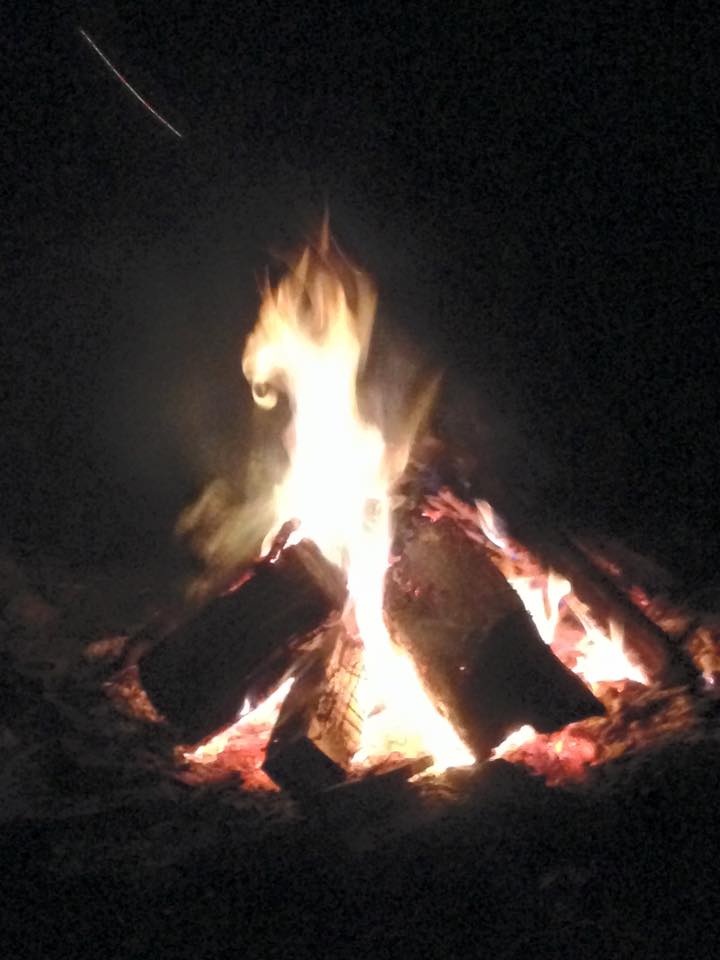
Not the sublime Agni puja that I will one day perform, but this was a hallowed fire that went from purifying to warding to cooking (Argh! Three functions!) through the course of its burn. It got me thinking about what my practice of sacred fire-tending will look like. It also got the space cleared out and ready for a better fire-ring, once I dig out all that mineral-rich soft ash. I posted a picture of my humble fire on the Facebook page for “Beacons in the Dark: a Global Anti-Fracking Convergence.” The ‘likes’ came in from places like Lancashire and Wolverhampton, UK, Trento. Italy and Columbus, Ohio. This was meaningful to me and made me felt connected to their own good efforts through my beacon-fire.

12038428_10205290927855816_7534681782774135577_n

On Golden Awen

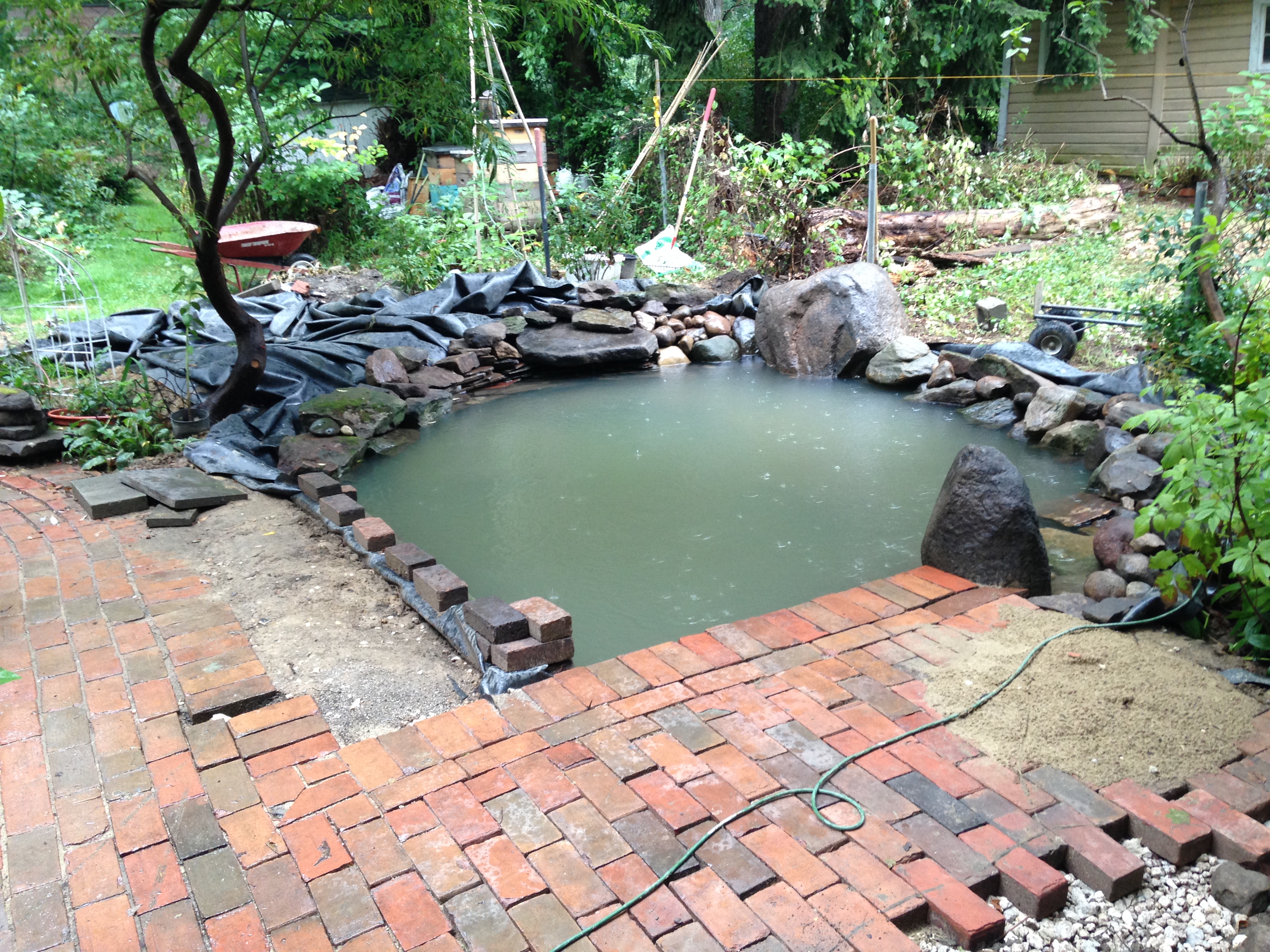
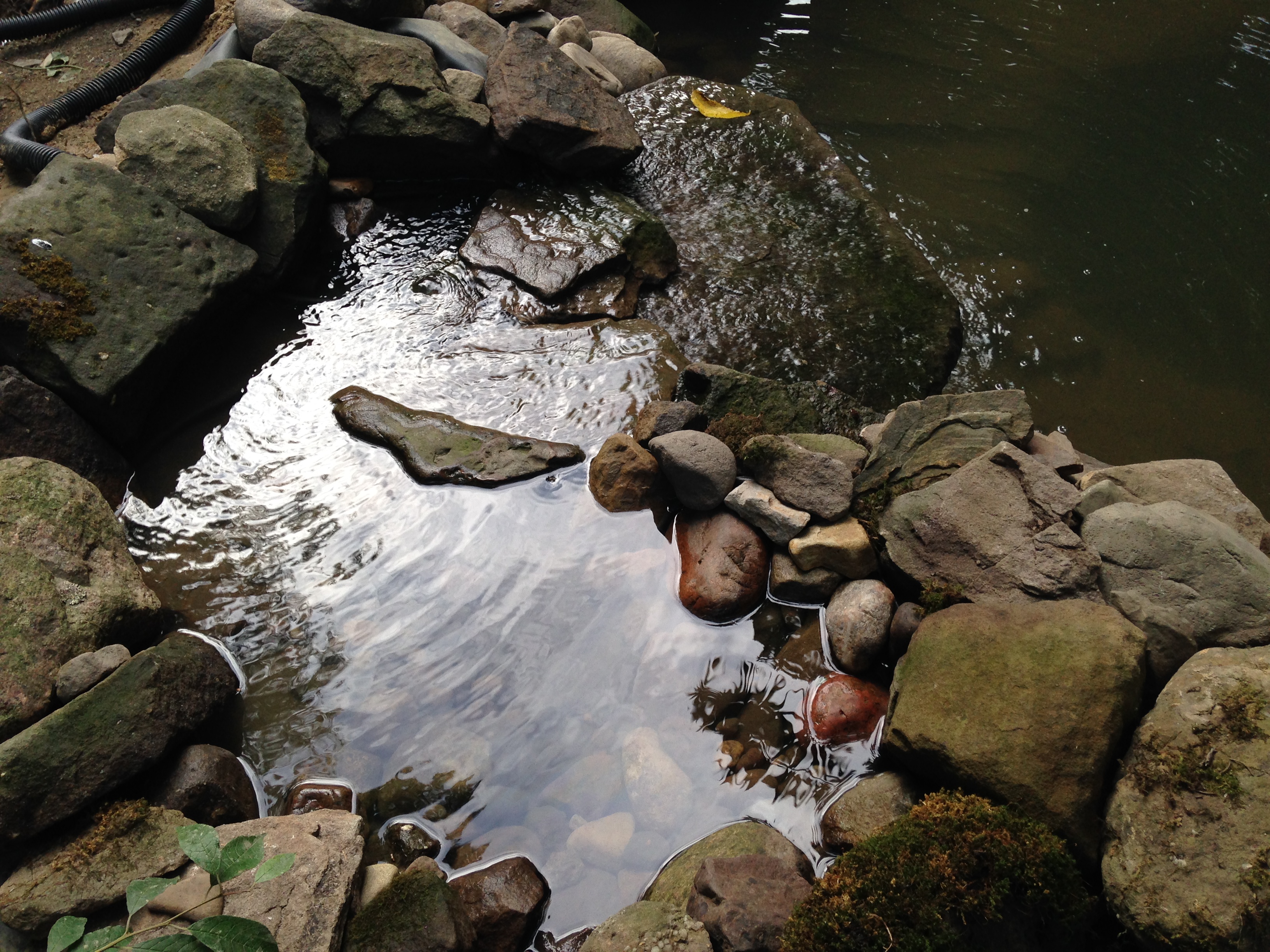
My husband and I are building a pond in our yard, one of fairly significant size for a city backyard. It’s not just a small water feature, but rather a lozenge-shaped pool about ten by twelve square feet, with broad shallows on one side and a maximum depth in the center of more than three feet. I’ve been hauling all the stones that I have, all the boulders, pebbles, cobble-sized chunks, river gravel, etc. that were placed at some point in my gardens from our many pilgrimages and adventures. The pond has a “spring,” that feeds an upper pool, bubbling up from between stones where the pump secretly feeds water through a filter, circulating the renewed water to fan over a delightful little waterfall. I placed, in the pool, treasures gathered from glacial lake bottoms, rivers and along shores of places that I have visited, trinket offerings of shiny agate, wave-tumbled, milky translucent quartz and granite flecked with pyrite, flashing like salmon scales, my own shrine to the Well of Inspiration.

Setting up a water-feature is a liminal act, because pond-building is basically contrived, ‘un-natural,’ in that it creates something via artifice that wasn’t there before and wouldn’t be under normal circumstances. Yet once it manifests, it begins to change the area around it independent of its human makers. It’s amazing how much capacity we have as human animals to alter eco-systems, fell whole forests, channelize rivers, raise and lower the grade for roads. In our own case, we have altered matters only slightly more than a beaver, albeit with glacial erratics, not felled trees and the water to fill the pond was diverted across town from the artisian wells that made Kent, Ohio famous. Of course, the pond-liner was dredged from ancient lake bottoms and seas, drawn up as petroleum, and it sits there today, tight as a drum holding in two evenings worth of flow from the garden hose.

Unfinished, yet already cardinals splash in its gentle waterfall, grackles rejoice over the new bath-house, amphibious creatures swing by to check out the safety of new nooks and crannies. I know that bending over the edge, flashlight in hand to spy one of a dozen speckled feeder fish hardly counts exactly as catching and burning your thumb on the Salmon of Knowledge. Still the flash of a free little fellow, glistening briefly, then eluding sight, is so much like the golden Awen moments that happen in a poet’s day. Poetic thoughts swim out of sight just as deftly, avoiding capture unless the mind immediately engages in some mnemonic trick to try to hold it for later.  

photo 1 (2)photo 2 (2)

photo 1 (3)

A modern fili has to resort to a little calico-print bound journal, my own personal “Speckled Gate” on hand to quickly capture those thoughts as by they dart. Our contrivance of a wild spring and pool of knowledge will include several shrines adjacent the pool, laid into the stones, including one dedicated to the Gaulish well goddess Brixta from Gallo-Roman Luxovium, now Luxeuil-les-Bain in Burgundy, historically a place of hot springs and baths…and since then being oft-pillaged, too, by Huns, Magyars, Saracens and Vikings. I had formerly used this stone in a shrine to the Matrones to specifically honor Brixta. When we began to conceptualize the plan for the pond, I set this stone aside to incorporate into the area dedicated to be the source of the water.

There are those who make the case that Brixta is a Gaulish Brighid, at least in her well-keeper aspect. There are also scholars who claim her name to be cognate with the Alpine goddess Berchta. The etymology also suggests that this may be a title like ‘Brig,’ possibly for Sirona, or it may be derived from the Gaulish word ‘brixtom’ or ‘brixta,’ meaning curse, a word also found on the ancient lead tablet of Chamalières, suggesting her domain may include spellcraft. All of this is conjecture because the only real attestation we have of her comes from Roman inscriptions on enduring stone monuments, assembled in gratitude for her aid and that of her consort Luxovius, such as this one “Luxovio / et Brixtae / G(aius) Iul(ius) Fir/manus / v(otum) s(olvit) l(ibens) m(erito), To Luxovios and Brixta, Gaius Julius Firmans freely and deservedly fulfilled his vow.”

Brixta and Luxovius presided over contrived bodies of waters. Ancient baths fed by hot springs are known to be holy sites of healing and renewal, but somebody had to engineer the bathhouses. Luxovius name suggests a connection between light and healing waters. Irish Filidecht also connects light and waters, Imbas Forosnai being described as “Great knowledge that illuminates,” its wisdom bubbling up from a well of inspiration. Right now it’s just me with a flashlight hunting for feeder fish in the dark, spotting the brave little calico fish who several nights running has come to the surface to check out the gleam, abiding long enough to possible be a poem darting in my mind, certainly long enough to be named “Awen.”

Red & Green, Stone & Stream: The Nature Spirits

A little update about where I am at this week with this Blog, my Poetry & writing for the ADF Naturalist Guild:

I have a journal full of notes, inspired by pond-building, that I hope to coalesce into an essay in the next day or so.

I’m hoping to find time to write about “the Speckled Gate” in the Irish lore and why I chose this title for my blog.

I also have a lot of exciting Imbas Forosnai homework to do in my Filidecht course with P. Sufeus Virius Lupus, which is absorbing a lot of my focus.

Until such time as this work is complete and share-worthy, I thought I would leave you an essay from my Dedicant program for Ár nDríaocht Féin, concerning the branch of the three kindreds commonly known as “the Nature Spirits.”  If my readers can understand how deep and enduring my relationship is with these entities, then they will understand more how I come to be aware of and serve them now today in my spiritual work. This might be 101 material to many, nevertheless I felt this was one of my best essays in my DP work, especially since it moved me emotionally to write it.
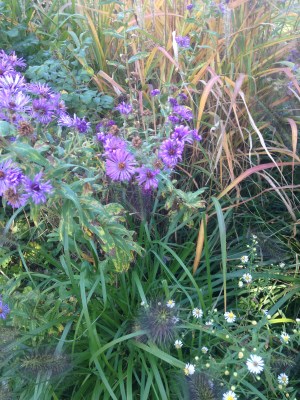
Featured imageIMG_0333IMG_0802

Red and Green, Stone and Stream: The Nature Spirits

The first word I uttered as a babe was “Flower.” Nature spirits mark the earliest spirit-kindred I came to know, feeling their presence even as a child. Such encounters confounded me, since my parents’ church insisted that these were demonic manifestations. These nature spirits refused to be banished from my mind’s eye. Stalwart tree spirits comforted my insecurities as I leaned against them, butterflies encircled me with flitting blessings. One time I played hooky from church, walking along the Menominee River. A crow flew down from a tree, landing atop my head, grasping copper-shiny, freshly-washed hair in her beak. I lay in bed that night furiously pondering the meaning of such a visitation.

My mother collected illustrated books with drawings of giants, faeries, dragons and goblins. Supposedly stories for my entertainment, they were instead illuminations of what I was already sensing. Role-playing games afforded me a first unreliable introduction to the hierarchies that comprise the world of non-human spirit. In the university gaming community I made friends who were exploring Paganism. We would do divination and discuss magic all night. Then, in the dark on our way home, we would run smack-dab into terrifying spirit manifestations. Some were eerily seductive, trying to lure me out on to the thin ice of Lake Mendota or to brazenly stand up on a hill in a lightning storm.

I realized I must learn quickly how to handle my wide-open psyche to relate safely to encountered spirits. Living at that time near Circle Sanctuary in Wisconsin, I attended Selena Fox’s Nature Spirit Retreats, conducting solitary meditations on the land to gain gifts from these allies. Later working in a Wiccan coven, I learned four-fold elemental divisions, represented classically as sylphs, salamanders, undines, and gnomes, corresponding with the four Aristotelian elements and cardinal directions. This system always seemed awkward to me, like trying to stuff a menagerie or botanical garden into a file cabinet.

Although my polytheist relationship with deity has changed over several decades, my watchful perception of  nature spirits endures. Our natural world is populated with many tribes from homestead and garden, farm, countryside, and untamed wild places. Clearly some of these spirits have made long alliances with humans, like animal allies who have become our pets, herds, and hives, and the wights of our farm-fields, including the spirit of the grain who consents to be cut-down for bread and fermenting barrel. Herbalism is a path of power that I embrace. I work with spirits described by the Scottish Findhorn community as ‘devas‘ of healing plants, who have guided my wort-cunning, the brewing of tinctures and teas, and formulating of incense.

Since the Victorian Era, the Fair Folk have been depicted as winged, diminutive and cute. Yet the older lore details all manner of spirit entities, wee or giant, dwelling below the earth like dwarves or in burial mounds like the Daoine Sidhe, inhabiting dark-wood and mountain like the landvaettir, or a dimension near our own, like the Norse view of Alfheim. Some spirits are individual guardians of holy places like waterfalls, wells, grottos, and springs. Others are members of vast courts, serving higher spirits, even the Shining-Ones themselves, as daemon-courtiers, emissaries, and wards. These entities may be described from a ceremonial magical perspective as angels or demons.

The non-human Not-Gods are vast in number, and there is no guarantee when encountered, that these spirits are friends. Our forebears found it best to not use the “F-word” (faery) directly when referring to these folk, rather to substitute the titles “Good Neighbors,” or “the Gentle-folk,” which establish a humble air of respect and nonchalance, keeping fickle, potentially mischievous spirits from being too overly curious. Some nature spirits have nightmarish aspects, like bugbears, pookas, or the Alp-traum spirits who sit on your chest while you sleep, whispering fearful murmurings into your ear. We know from the lore that the Irish Sidhe are divided into Seelie (benevolent) and Unseelie (malevolent) courts, but even spirits who are not ill-willed can be dangerous and may toy with novices and fools. It is important to approach these spirits with high courtesy. It may be necessary to use tools as is appropriate with various sorts of spirits, like a wand or blade, sigils, holy stones, etc.

The best way to gain the favor of nature spirits is through reciprocity in the form of regular sacrifices. Offerings may be made in thanks for a favor, or as part of a bargain, including propitiation to spirits in the hopes of avoiding trouble. Our ADF offerings to Outdwellers fall into this category. It’s worth noting here as well that these spirits can include negative entities we ourselves make with the power of our minds, like the toxic byproducts of jealousy, conflicts, and suffering. These, too, can become energies that endure in our environments and bring dis-ease.

Preferred gifts for nature spirits include buttons, silver, ribbons, meal, birdseed, milk, whiskey, flowers, fruit, even compost, depending on the sort of entity with whom we are seeking a hospitable relationship. An offering to avoid would be cold iron, which wards against these spirits. One excellent practice is to maintain a wild space on your property, un-mowed, for them to inhabit and receive sacrifices. In urban areas, city land, gone-back-to-wild, can be highly charged with energy and excellent places for landless apartment dwellers to leave offerings. One should still exercise caution. Nature spirit’s habitat has been horribly disturbed in the last century by development and pollution, so they are justifiably suspicious of humans.

Cómhla Breac: The Speckled Gate

This is the maiden entry of a blog that I have been promising my community of friends for some time. I will begin with where I am now…  as a flegling student of Filidecht, the medieval style of Irish poetry and at the commencement of my post-Dedicant training in Ár nDraiocht Fein, along the path so beckoningly laid out by the Naturalist’s Guild. These will be snap-shot entries in a journey, one that will lead from garden and stead through the realms of Poesy and perhaps even, at times, through “the Speckled Gate” into the Otherworld itself. A modest trip, but one that may prove enriching to my readers nonetheless.

.  .  .  

     As I commence my Nature Awareness Journal for the work of the ADF Naturalist Guild, I find myself reflecting with mirth and some bemusement on the requirements, especially the instructions to “Grow something.” Don’t get me wrong; I think this is a wonderful suggestion, probably one of the most important in all the list. It’s just that I can hear the characters of all my beloved plants clamoring over each other to receive the coveted prize to be the “something” that is grown and featured in this part of the requirement. The truth is that I am already responsible for the care of many plants. Yeah,… like lots and lots of plants, ranging from the perkiest of short-lived exuberant annuals, to trees that are no longer the saplings that I planted but now sentinels of blossom and foliage color in an urban forest understory. Not to mention the hundreds of gorgeous seasonal perennials filling in between, plus a modicum of food plants that will tolerate the high shade of my wooded space.

That has me wondering… Should I report on what I already have growing or should I plant something new, something I have never grown before? The quandary there being that after years of investing money and time in plants that were not native to my habitat or so fancy as far as hybridization, I (and the plants) have grown weary with trying to get the unadapted to adapt to my sandy-soiled sloping wooded space. So for the most part, I have stuck with a themed blend of what I know will work as far as herbs, prairie plants and reliable shade-lovers like hellebores and hostas.

We have just begun work on a pond in our yard. I am contemplating investing some money in hardy water lilies and other pond-loving aquatics. I have not yet ordered any of these plants because the work is still underway, so I do not have an adequate home for them yet. (Actually, that’s not entirely true, I did order 50 Wedgewood-blue camassia bulbs for the border areas around the pond. I just can’t help myself…) I do have the aquatics nursery picked out and have been eying up varieties in an on-line catalog operated by another green-thumbed member of our hippy tribe. There are some truly lovely examples in his catalog, too, that appear to glow in the photos with an inner light like little, floating stained glass lanterns.

I also thought this might be the time to take-up the art of fruit tree grafting, something I have always wanted to learn. Then again, where in this crowded space will I put any new trees that would be the result of these unions, especially since I already have at least four unidentified stone-fruit saplings to relocate that have germinated along the walk up to the side door from seasons of my own offspring eating the fruit and then pitching the pits into the fertile soil I built layer-by-layer in the flanking garden beds?

Perhaps the chosen plant should be a new houseplant for the winter months, since a good part of this journal will be unfolding as the weather cools. Right now, it’s just too hot and too frighteningly dry to plant anything, and all my energies are consumed with watering the “babies” I already have while I keep hoping for a real rain.