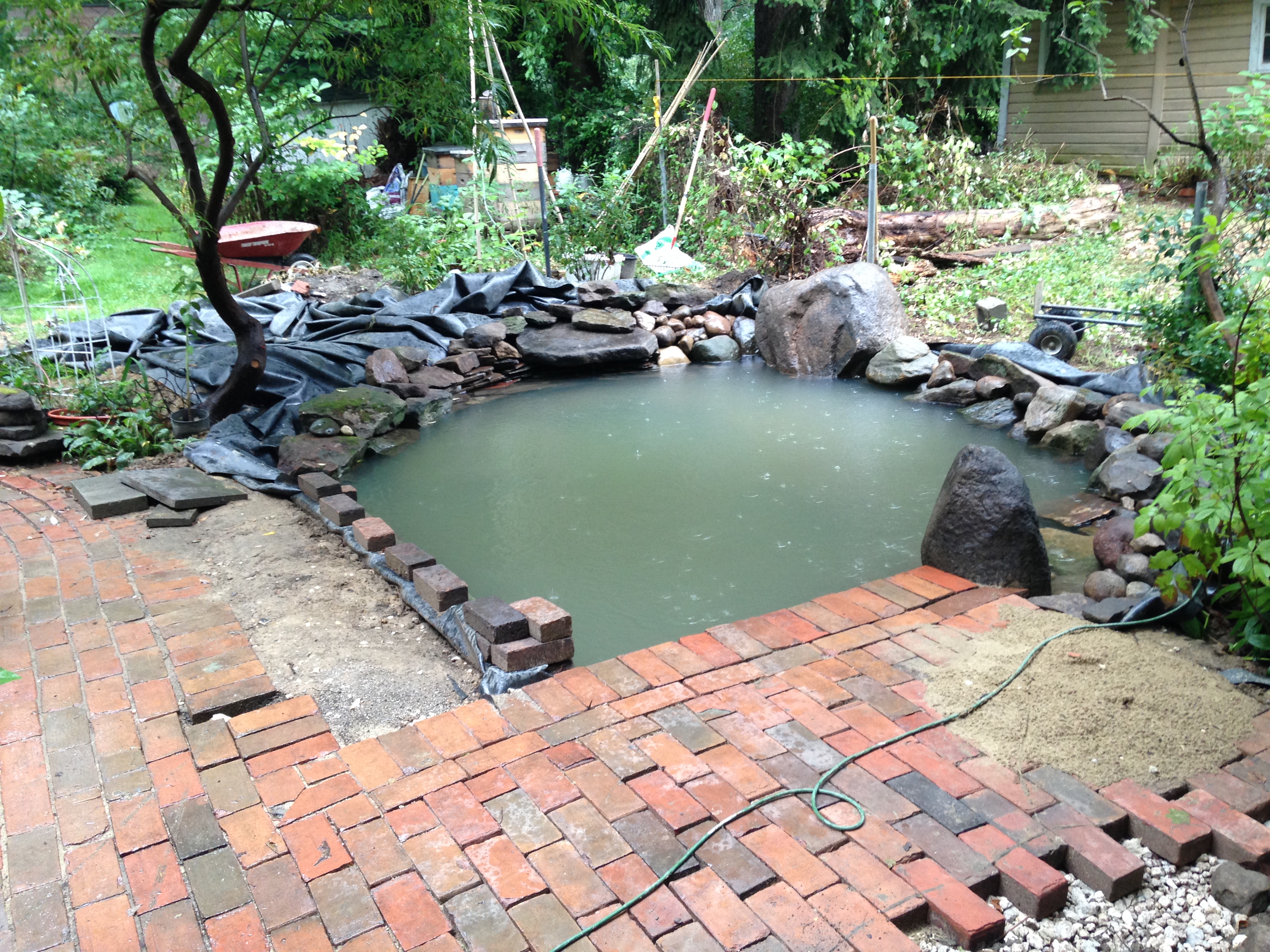
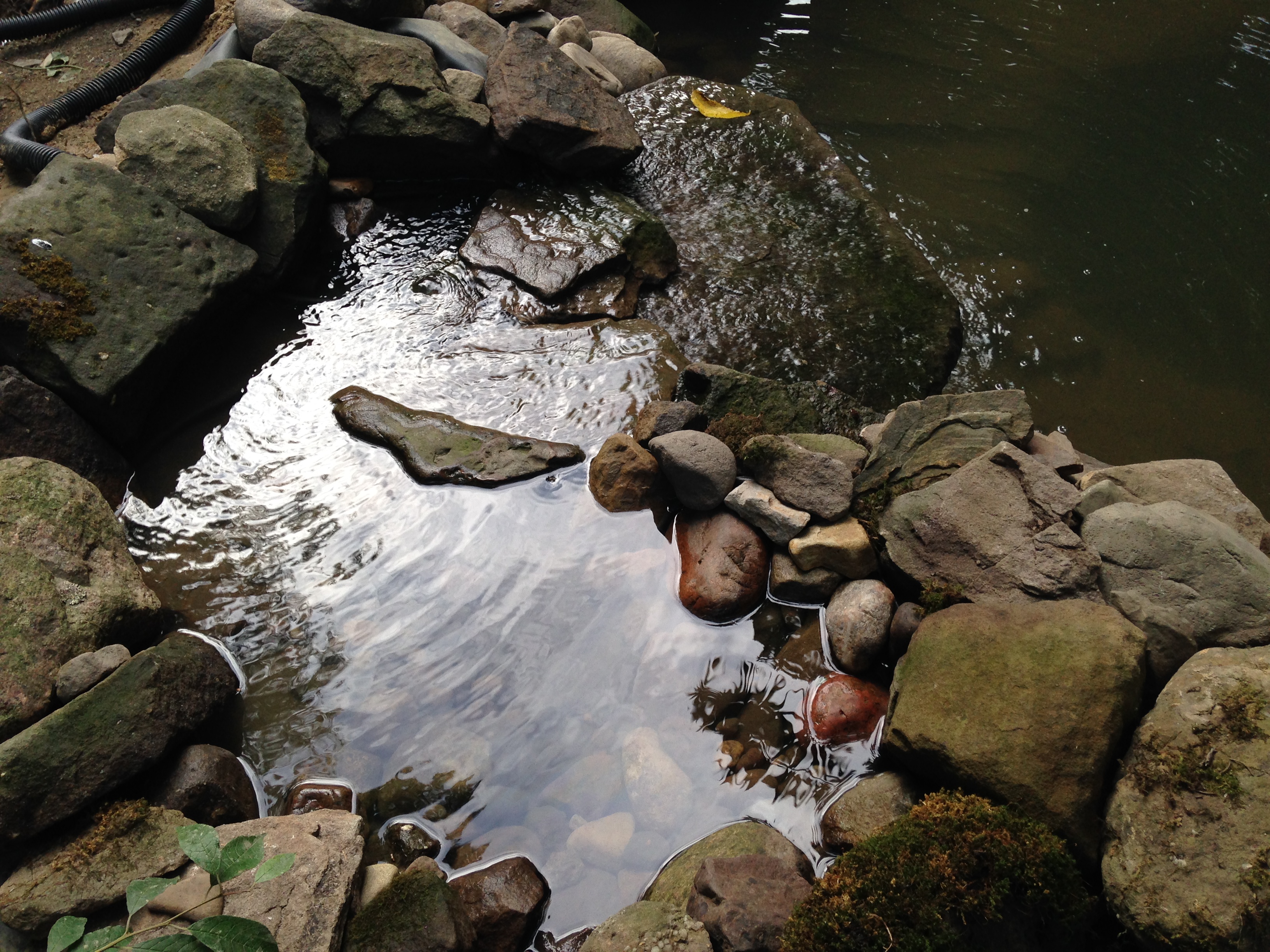
My husband and I are building a pond in our yard, one of fairly significant size for a city backyard. It’s not just a small water feature, but rather a lozenge-shaped pool about ten by twelve square feet, with broad shallows on one side and a maximum depth in the center of more than three feet. I’ve been hauling all the stones that I have, all the boulders, pebbles, cobble-sized chunks, river gravel, etc. that were placed at some point in my gardens from our many pilgrimages and adventures. The pond has a “spring,” that feeds an upper pool, bubbling up from between stones where the pump secretly feeds water through a filter, circulating the renewed water to fan over a delightful little waterfall. I placed, in the pool, treasures gathered from glacial lake bottoms, rivers and along shores of places that I have visited, trinket offerings of shiny agate, wave-tumbled, milky translucent quartz and granite flecked with pyrite, flashing like salmon scales, my own shrine to the Well of Inspiration.
Setting up a water-feature is a liminal act, because pond-building is basically contrived, ‘un-natural,’ in that it creates something via artifice that wasn’t there before and wouldn’t be under normal circumstances. Yet once it manifests, it begins to change the area around it independent of its human makers. It’s amazing how much capacity we have as human animals to alter eco-systems, fell whole forests, channelize rivers, raise and lower the grade for roads. In our own case, we have altered matters only slightly more than a beaver, albeit with glacial erratics, not felled trees and the water to fill the pond was diverted across town from the artisian wells that made Kent, Ohio famous. Of course, the pond-liner was dredged from ancient lake bottoms and seas, drawn up as petroleum, and it sits there today, tight as a drum holding in two evenings worth of flow from the garden hose.
Unfinished, yet already cardinals splash in its gentle waterfall, grackles rejoice over the new bath-house, amphibious creatures swing by to check out the safety of new nooks and crannies. I know that bending over the edge, flashlight in hand to spy one of a dozen speckled feeder fish hardly counts exactly as catching and burning your thumb on the Salmon of Knowledge. Still the flash of a free little fellow, glistening briefly, then eluding sight, is so much like the golden Awen moments that happen in a poet’s day. Poetic thoughts swim out of sight just as deftly, avoiding capture unless the mind immediately engages in some mnemonic trick to try to hold it for later.

A modern fili has to resort to a little calico-print bound journal, my own personal “Speckled Gate” on hand to quickly capture those thoughts as by they dart. Our contrivance of a wild spring and pool of knowledge will include several shrines adjacent the pool, laid into the stones, including one dedicated to the Gaulish well goddess Brixta from Gallo-Roman Luxovium, now Luxeuil-les-Bain in Burgundy, historically a place of hot springs and baths…and since then being oft-pillaged, too, by Huns, Magyars, Saracens and Vikings. I had formerly used this stone in a shrine to the Matrones to specifically honor Brixta. When we began to conceptualize the plan for the pond, I set this stone aside to incorporate into the area dedicated to be the source of the water.
There are those who make the case that Brixta is a Gaulish Brighid, at least in her well-keeper aspect. There are also scholars who claim her name to be cognate with the Alpine goddess Berchta. The etymology also suggests that this may be a title like ‘Brig,’ possibly for Sirona, or it may be derived from the Gaulish word ‘brixtom’ or ‘brixta,’ meaning curse, a word also found on the ancient lead tablet of Chamalières, suggesting her domain may include spellcraft. All of this is conjecture because the only real attestation we have of her comes from Roman inscriptions on enduring stone monuments, assembled in gratitude for her aid and that of her consort Luxovius, such as this one “Luxovio / et Brixtae / G(aius) Iul(ius) Fir/manus / v(otum) s(olvit) l(ibens) m(erito), To Luxovios and Brixta, Gaius Julius Firmans freely and deservedly fulfilled his vow.”
Brixta and Luxovius presided over contrived bodies of waters. Ancient baths fed by hot springs are known to be holy sites of healing and renewal, but somebody had to engineer the bathhouses. Luxovius name suggests a connection between light and healing waters. Irish Filidecht also connects light and waters, Imbas Forosnai being described as “Great knowledge that illuminates,” its wisdom bubbling up from a well of inspiration. Right now it’s just me with a flashlight hunting for feeder fish in the dark, spotting the brave little calico fish who several nights running has come to the surface to check out the gleam, abiding long enough to possible be a poem darting in my mind, certainly long enough to be named “Awen.”

